
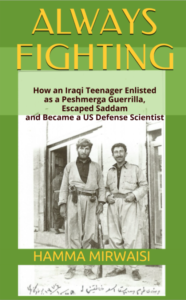
How does a designated international terrorist who may also be the world’s worst student become a US defense scientist?
As this candid, irreverent , heartfelt, and occasionally hilarious memoir explains, it ain’t easy. Much of it is hard to believe, but it’s all true.
Nothing about Hamma Mirwaisi’s life has been easy. Life is that way when you are a member of an oppressed minority group (the Kurds) in a country ruled by an already psychotic regime: the Iraq of Saddam Hussein. On top of that, he made his life even harder than it had to be through his own attitudes and choices, especially the choice to let things come out of his mouth at the worst possible moment.
His father was little more than a goatherd in a rural village, but managed to scrape together the fees to send him to an Islamic religious school (madrassa). In a series of misadventures, Hamma is expelled from one madrassa after another, but there is no harm done to his education because most of the imams weren’t literate enough to give him one anyway. He then spent the next 15 years trying to complete a secular education, when he and his father can scrape the necessary bribes together; to that end, as a young teen he begins running a black-market trucking operation. School takes a lot longer when it is constantly interrupted by having to skip town to evade angry parents or avoid arrest, or when the Iraqi government launches its periodic crackdowns on the Kurds.
Eventually he has no choice left but to join the Kurdish guerrillas (peshmerga) battling the government. There he finds a place where he can fit in, … if he can survive the murderous infighting within the Kurdish factions.
Once peace is declared, even though he is one of the few people in his province that even has a high-school diploma, as a former rebel he is shut out of most paying jobs, so he slips across the border into Iran in hopes of securing work with his former guerrilla commanders who hold court there. There’s no relief in that corner and eventually he finds a way to join an immigration program that randomly assigns him to the USA. On arrival, he finds that the milk and honey is going to require a lot of work (something he hasn’t done much of). He also tests the considerable limits of his Christian sponsors’ charity, but they are far more dependable than his fellow countrymen and coreligionists .who see him as an easy mark. Eventually his sponsors do find him an opening at college, and this too poses significant challenges for a young man with a wife and children but little English. With his wife’s long-suffering support he matures and applies himself and, despite more misadventures, finds himself at long last able to provide a stable living for them.
Along the way, we’ll learn a great deal about who the Kurdish people and their peshmerga soldiers are, their struggle for recognition and respect, and the lethal internal squabbles that tend to make them their own worst enemies.
EDITORIAL REVIEW
This book reinforces the adage that ‘One person’s terrorist is another person’s freedom fighter’ with a fascinating and uniquely personal perspective of growing up in a Kurdish village and how the family and religious strictures of community life, combined with international political realities, led to initial contact with Peshmerga fighters in the early 1960s. The author describes individual combat skirmishes during that decade, as well as the challenges and subsequent life choices that eventually led through refugee status to the United States and paved the way for his eventual work in the U.S. defense industry. Scott Gourley, Contributing Editor, ARMY Magazine.