

The book I have been waiting for was worth the wait. Robin Benger is a noted documentary journalist whose travels have taken him to most of the world’s trouble spots, but his prior published work was journal about some
months he took to et away from it all. Now we get a look inside the events that led to some of these tremendous stories. Benger notes in the foreword that Rategan is a fictionalized avatar for the author, one who says and does the things we wish we would have said or done in a particular situation. It is a little disorienting for the reader, since Benger himself did say and do many of those things and has it on tape to prove it.
What does Rategan get up to? Deep cover stories about the horrors of civil wars, oppressive governments, or dysfunctional societies. Rategan meets underground cells in Mozambique, El Salvador, and Peru. As a semi-voluntary exile from apartheid in his non-fictional life, the author’s biggest emotional moment is the opportunity to return to South Africa and meet the Mandelas whom he has long idolized from afar. For me, the most striking chapter was the coverage of a sub-culture within Toronto that was just as dysfunctional as any of those he found in far-flung battle zones. Throughout the book, Rategan’s driving need is to find the underdogs in unfair fights and broadcast their stories to the world, or at least to Canada. As narrator, Benger is sufficiently self-conscious of his idealistic urges and biases and allows himself and the reader regular doses of macabre humor and irony as Rategan is usually disappointed (if not dangerously betrayed) by the very people he has come to help.
Benger tells us that he split his sort-of memoir into 3 parts to make the books a readable length. Fair enough, but don’t make us wat too long for installments 2 and 3. If you take anything away from this book, it is that you just never know what is going to happen next, so you’d better make the best of a good thing while it lasts.
![The Old Boys by [McCarry, Charles]](https://images-na.ssl-images-amazon.com/images/I/51pjfVZFTDL.jpg) An excellent yarn about a group of former spies getting together for one last caper. The premises are an entertaining homage to several classics in this field – a central character who is declared to be dead but may not be, the mysterious jihadist who has also returned from the dead, and (surprisingly) a long-lost Gospel that could have enormous repercussions. This last item is in fact an enormously intriguing concept but it serves only as the omnipresent McGuffin; I should like to have seen it developed a lot further.
An excellent yarn about a group of former spies getting together for one last caper. The premises are an entertaining homage to several classics in this field – a central character who is declared to be dead but may not be, the mysterious jihadist who has also returned from the dead, and (surprisingly) a long-lost Gospel that could have enormous repercussions. This last item is in fact an enormously intriguing concept but it serves only as the omnipresent McGuffin; I should like to have seen it developed a lot further. Two recent offerings from Nelson DeMille explore his similar but different sub-genres and both are well worth your time.
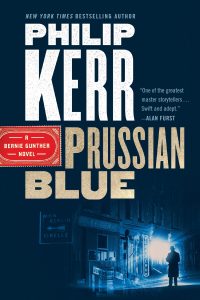 An excellent read in another of the Bernie Gunther series of WW2-era detective novels. As is the style for the series, the story alternates between a post-war case in which Bernie is involved as a private eye and a pre-war case in which he is engaged in his capacity as a police detective working (under slightly more degree of protest than the regime tolerates) for the Third Reich. The link between the two stories in this case is Friedrich Korsch who had been his understudy in the prewar years; after the war, as a Berliner, Korsch has to work (also with some reservations) for the Soviet puppet government in East Germany, and in that role is responsible for making sure that Bernie does not discover or undermine what his new bosses are up to.